
JIDP is an innovative project whose goal is to use sport to promote the social and cultural integration of adolescents with intellectual disabilities (ID). Research has shown that participation in judo can have both social and health benefits for people with ID. With this potential in mind, this project has been undertaken with the aim of expanding the presence and reach of judo programs for people with ID to the greatest extent possible to make them accessible to the largest number of people.
The project will promote a healthy nutrition strategy along with physical activity in an effort to improve the quality of life of adolescents with ID. In order to accomplish this, a smartphone app will be created in the context of the project, and this tool will be applicable for use with other sports in future projects.
The project will train adapted judo instructors and help expand their knowledge, leading to a ripple effect of benefits after the intervention is finished. This will be accomplished via training meetings and through the creation of a virtual training platform that will help guarantee the training of future adapted judo instructors. JIDP can boast the participation of eight partners from six European countries. The role of six of the partners will be to develop a judo program and to collect information to help improve its implementation, while the two institutional partners will help in the communication and dissemination of the results. The program will benefit more than 120 adolescents with ID with direct participation in judo programs and more than 18 instructors who will participate in direct training during the program, along with more than 80 future instructors who will be able to receive training through the virtual platform.
This project directly responds to the European Erasmus + priority "promoting social inclusion and equal opportunities in sport", in this sense it uses the results of previous ERASMUS + SPORT projects (AUTJUDO, IKONS, PRIME) and complements them by providing new and innovative resources.
Insufficient physical activity and a sedentary lifestyle among people with ID are linked to social and cultural factors, economic and educational barriers, health problems, and discrimination against various groups. Specifically, adolescents are among those with the fewest opportunities to access physical activity (PA) and have rarely been specifically targeted by PA programs. The main objective of this project is to improve the quality of life of adolescents with ID through inclusion in the practice of judo. JIDP is a project that brings together eight organizations from six European countries (Greece, Italy, Ireland, Portugal, Spain and Switzerland) with the aim of continuing a series of parallel experiences in the development and implementation of adapted judo sessions for adolescents with intellectual disability (ID).
This project is mainly aimed at adolescents with ID, but it will also have positive effects on parents and the broader population. The project is designed to promote sport and physical activity, to use sport and social inclusion to promote friendship and solidarity, and to
enhance mutual knowledge of different cultures. Its guiding principles are social inclusion, sustainability, and a commitment to training volunteers and sports technicians to work with this group.
Rationale of the project
Practicing PA and reducing sedentary lifestyle are key determinants of an improvement in quality of life. -PA and sports programs are rarely combined with nutritional strategies. -Sports programs based on judo have shown to be effective in children with ID at the level of enjoyment and improvement of physical fitness. -The perspective of social inclusion is urgent in PA programs aimed at adolescents. -PA trainers, physiotherapists and students/volunteers (as future professionals) must be trained to apply appropriate strategies with people with ID.
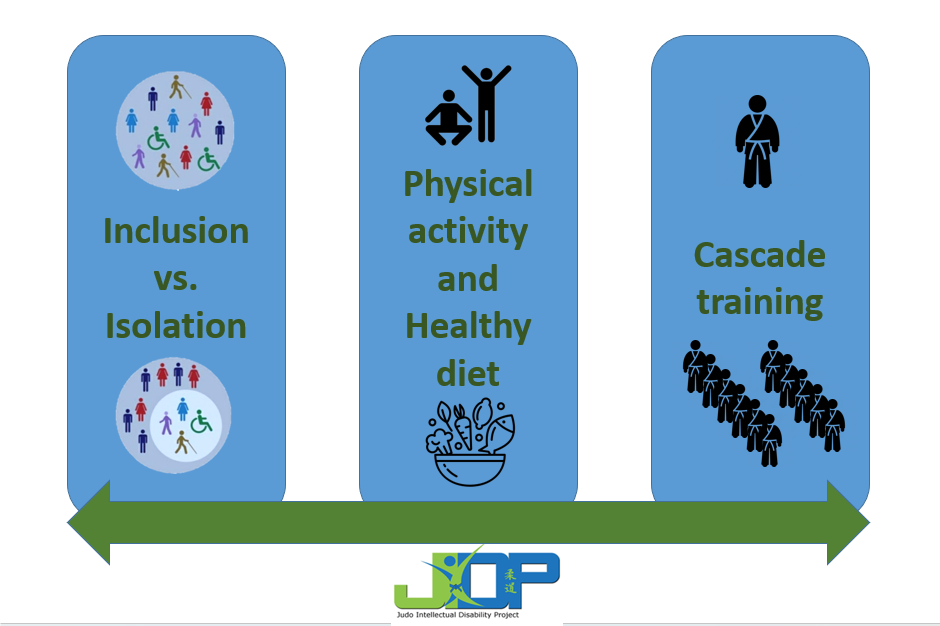
The intervention to be carried out within this project takes advantage of resources from previous projects, such as the AUTJUDO and PRIME practical guides, and complements them with broader actions aimed at adolescents regardless of their type of intellectual disability, combining PA and nutritional strategies and creating a cascade effect on the training of professionals who care for people with ID. To conclude this section, the following figure visually illustrates the entire dimension of the JIDP intervention.
Needs analysis
The practice of exercise and physical activity (PA) is one of the most important factors for improving the physical and mental health of children and adolescents (Janssen & LeBlanc, 2010; Loprinzi et al., 2012). World Health Organization guidelines recommend an average of 60 min/day of moderate to vigorous intensity aerobic PA and regular muscle-strengthening activity throughout the week in order to yield health benefits in children and adolescents (Bull et al. al., 2020). However, several studies report that children and adolescents with ID are inactive and do not meet said PA guidelines (Boddy et al., 2015; Einarsson et al., 2015). Compared with their typically developing peers, adolescents with ID have a lower participation rate and lower intensity PA (Einarsson et al., 2015; McGarty et al., 2018).
ID is defined by a significant limitation in both intellectual functioning and adaptive behavior, which covers many everyday social and practical skills. This disability originates before the age of 22 (Schalock et al., 2021). Children and adolescents with ID experience many health disadvantages with respect to their typically developing peers, including higher rates of mental health problems, obesity, type 2 diabetes, and other health conditions that can continue into adulthood (Maiano, 2011). Indeed, the severity of these health inequalities means that children and adolescents with ID have a life expectancy of up to 20 years less than people without ID (O'Leary et al., 2018). Although the average life expectancy is lower for people with ID than for the general population, in some cases, people with ID do live as long as their non-disabled peers. In fact, the trend in recent decades has been for the life expectancy of people with ID to increase significantly, although it is still below the life expectancy of the general population (Dieckmann et al., 2015). Therefore, it is critical that these health inequities are addressed and methods are identified and developed to improve the health of children and adolescents with ID.
The physical and mental health benefits of PA practice in the population with ID have been widely demonstrated in scientific literature. There are works from systematic reviews and meta-analyses that indicate that exercise can lead to psychosocial (Kapsal et al., 2019), physical conditioning and overall health (Bouzas et al., 2019; Mirza et al., 2022a) improvements. Other studies have observed the effect of physical exercise with different configurations, varying the intensity and frequency in different groups with ID (Elmahgoub et al., 2011; Oviedo et al., 2020). There is also a considerable volume of scientific literature that highlights the benefits of PA and sports programs in specific groups with ID, such as the population with Autism Spectrum Disorder (ASD) and Down Syndrome (DS). Individuals with ASD who participate in physical activity programs show improvements in social and communication skills (Bremer et al., 2016; Howells et al., 2019), motor skills (Colombo-Dougovito, 2015; Crucitti et al., al., 2020) and in health-related physical condition (Healy et al., 2018, Sam et al., 2015). Along the same lines, individuals with DS who participate in PA programs show improvements in cardiorespiratory health and physical fitness (Barnard et al., 2019; Pitetti et al., 2013). The benefits of children and adolescents with ID participating in specific organized sports programs have been investigated for some time, for example, swimming and aquatic exercise programs with children with ASD (Fragala-Pinkham et al., 2011; Pan, 2011), participation in an adapted basketball program with the aim of improving physical fitness and social skills (Cai et al., 2020), participation in structured PA (Arslan et al., 2020), programs based in adapted soccer games (Regaieg et al., 2020) or the effect of swimming on body composition in individuals with DS (Suarez-Villadat et al., 2020).
Need in adolescents
A very important aspect to take into account is that PA levels in children and adolescents with ID decrease with age, reflecting an increase in sedentary behaviour (Phillips & Holland, 2011). Most systematic reviews have found a negative relationship between age and PA, suggesting that the influence of age on PA causes adolescents with ID to show lower levels of PA than younger age groups. This could be attributed to the lower autonomy and greater dependence on parents that children and adolescents with ID have, compared to their typically developing peers who, in general, become more autonomous with age, especially when they reach adolescence (Sutherland et al., 2021). This trend continues into adulthood, as adults with ID have been found to engage in little or no PA (Ptomey et al., 2018). Because children and adolescents with ID have a higher prevalence of health problems than their typically developing peers, increasing PA could help reduce these health inequalities (Maiano, 2011). Furthermore, since childhood PA is a predictor of PA in adulthood, promoting active lifestyles at an early age will help promote long-term activity and health (McGarty & Melville, 2018). Therefore, the need arises to focus interventions on age groups of adolescents and young adults to compensate for this problem. Our research group has experience in interventions with participants with ASD in childhood (Morales et al., 2022) and other projects with different configurations of physical exercise with older adults with DS (Oviedo et al., 2020) and the evidence collected shows that the benefits achieved could be extrapolated to groups of adolescents and young adults.
Need to combine PA and diet
The prevalence of obesity among children and youth with ID exceeds that observed in typically developing children (Maiano, 2011; Segal et al., 2016). Children with ID who live in the same environment as typically developing children may have additional risk factors for obesity due to changes in body composition, motor skill deficits, barriers to physical activity, dietary selectivity, and medication use associated with weight gain (Bandini et al., 2021). Given the high prevalence of obesity and the lack of weight loss trials for this vulnerable population, there is a need to develop specifically designed weight loss programs with multi-component approaches that include diet, physical activity (PA), and behavior modification (Boutelle et al., 2017). Although they have been shown to be effective in treating childhood obesity among families of typically developing children, these interventions have rarely been adapted for youth with ID (Bandini et al., 2021).
Studies featuring interventions in diet and lifestyle with people with ID to improve their health are scarce, and the ones that have been carried out are mostly based on dietary modifications consisting of the elimination of unhealthy foods, without involving families and without specifying the frequency, intensity and the duration of the interventions (Mirza et al., 2022b). Most studies on diet and nutrient analysis in people with ID have shown a low consumption of fruits and vegetables and a high consumption of fat (Hoey et al., 2017; Marín & Graupera, 2011; Skrzypek et al., 2021). Most authors agree that it is necessary to promote actions and programs on how fruits and vegetables can be included in the kitchen and promote their consumption between meals (Adolfsson et al., 2008). It would therefore be opportune to implement projects that combine various strategies to improve the health of the population with ID, in which strategies of nutritional habits and PA are addressed in collaboration with families.
Barriers for people with ID
On the other hand, people with ID face numerous barriers to participation in sport and PA. The external barriers are extensive, including politics (lack of inclusive programs), poorly adapted facilities and professionals who have not been trained in a specific way. It has been estimated that 80% of parents of children with ID identified a lack of facilities as a barrier, but also noted that social factors and personal barriers related to stigma, negative peer perceptions and lack of trust were equally limiting (McGarty & Melville, 2018), demonstrating that it is necessary to develop programs that adapt to these situations, which include sports modalities that adapt to the characteristics of the population with ID and at the same time, promote actions that include specific training for sports coaches.
Use of judo with people with ID
The practice of martial arts and combat sports is perfectly adapted to the population with ID, since they are activities that integrate a moderate to vigorous intensity of activity, with added cognitive and emotional components such as concentration and self-control (Garcia et al., 2019). This type of activities has proven to be attractive for young people with ID due to the repetitive structure of their exercises (Bell & Allen, 2016). Even a recent study demonstrated the feasibility of a family-based adapted judo program for boys and girls with ASD (Garcia et al., 2022). There is research that supports the use of these sports, especially for improving motor skills in individuals with ID (Kim et al., 2016; Quinzi et al., 2022; Sarabzadeh et al., 2019), but also in the field of social behavior, for example, training karate kata induces significant improvements in stereotypical behaviors and social interaction (Bahrami et al., 2012; Movahedi et al., 2013).
The systematic review developed by Pečnikar et al. (2020), highlights the improvements in healthy parameters and social skills from the inclusion of people with ID in adapted judo programs. The practice of judo has shown positive results in short-term programs, seeing improvements in repetitive behaviors, social interaction and communication, and emotional response (Morales et al., 2021). Proof of this are the improvements reported in a study with an eight-week intervention (Rivera et al., 2020), in which a reduction in aggressive behaviors was found in children with ASD who participated in an adapted judo program. On the other hand, other investigations demonstrate the feasibility and effectiveness of this type of program, in which great acceptance and high rates of enjoyment were found, stimulating a high desire to continue the practice after the program (Tomey, 2017). It has been reported that the increase in adherence to adapted judo programs achieves an increase in the volume of moderate to vigorous physical activity (Garcia et al., 2019), fundamental for improving physical condition in children and adolescents. Recent studies show improvement in motor skills and cardiovascular health in a group of boys and girls with ASD who participated in an adapted judo program during a school year (Morales et al., 2022; Pierantozzi et al., 2022).